


 We said we had a sense of deja vu going into the State of the Union, but this is ridiculous.
Last night, President Barack Obama devoted 516 words to his call to finish work on health care reform, about five minutes of the talk. That is about 7.2% of the total 7, 127 State of the Union address he delivered. Remarkably, it is exactly the same portion of the speech that he devoted to health care in his first address to Congress 11 months ago (427 out of 5,923 words, if you are keeping score.)
And its about half the percentage that health care represents of the economy.
Stirring though the words may have been, their relative dearth suggests health care is hardly a make-or-break issue for 2010.
All of which means, Big Pharma has to think seriously about the consequences if Obamacare goes away.
Yes, it has reached the point where the US brandname pharmaceutical industry is hoping against hope that it can get someone to take $80 billion.
The famous deal between the Pharmaceutical Research & Manufacturers of America and the White House, which we dubbed "dollars for donuts," is up in the air, just like everything else related to health care reform.
AstraZeneca CEO and PhRMA board Chairman David Brennan made that clear at a press conference today tied to the company's year-end financial report. To Brennan's credit, he has said all along that the prospects for reform are uncertain, and today he underscored that things are more uncertain than ever.
And, in case there is any doubt, the collapse of health care reform would be a bad thing for Big Pharma. It is not just what won't happen--no bolus of newly insured customers, no filling in of the donut hole, no reduction in cost-sharing for existing insured, no new IP protection for biological therapies.
It is also what will happen. It is not like Pharma will just get to keep its $80 billion.
To us, the most important words for industry in the entire address weren't in the health care section at all, but earlier--when Obama called on Congress to tax overseas earnings. A year ago, Obama wanted to use that idea as a way to pay for health care reform, and that--maybe more than anything else--explains the deal PhRMA struck with the Administration. Industry came to the table, and the tax deferral on overseas earnings was taken off of it.
Not any more.
"To encourage these and other businesses to stay within our borders," Obama said last night, "it's time to finally slash the tax breaks for companies that ship our jobs overseas and give those tax breaks to companies that create jobs in the United States of America."
It took just 42 words to express that thought. But those are the words that could really count.
Thursday, January 28, 2010
Health Care Reform: Words, Words, Words

Thursday, January 21, 2010
Health Care Reform: Suddenly The Status Quo IS An Option
 Remember when this round of health care reform began? There was just one thing everyone agreed on: the status quo is no longer an option.
Remember when Pharmaceutical Research & Manufacturers of America CEO Billy Tauzin stood side-by-side with Families USA head Ron Pollack to declare that, past differences between the two groups notwithstanding, they would join forces to urge the Obama Administration to press on with health care reform?
Or America’s Health Insurance Plans CEO Karen Ignagni standing up during the White House health care summit, being called on personally by the president, to say that insurer’s would not repeat their role in blocking reform this time around?
Time and time again, we heard the same theme: in 1993-94, everyone supporting health care reform viewed the status quo as their preference if they couldn’t have reform just their way. This time it was different. The status quo was no longer an acceptable fallback.
The status quo is suddenly very much on the table.
Such is the impact of the unbelievable, unthinkable victory by Republican Scott Brown in the race for the Massachusetts Senate Seat formerly held by the late Ted Kennedy.
Sure, there are plenty of non-healthcare explanations for that outcome. Plenty of folks blame the Democratic candidate, Martha Coakley, for a less than stellar performance. And special elections are always unpredictable. (We drew a comparison before between this race and the kind-of-the-same-but –exactly-the-opposite election of Harris Wofford in Pennsylvania almost 20 years ago.) And Massachusetts already has universal coverage--or as close to it as any federal health care legislation would deliver.
But this is politics and symbols matter. Ted Kennedy passed the mantle to Barack Obama and made health care his legacy issue. There can be no more potent symbol of repudiation for the current reform path than the election of an avowed health care reform opponent from the opposition party to fill his seat.
That silence you hear is the stunned contemplation of all parties to the health care reform debate that the status quo might just be what they end up with after all. All those lobbyists. All those hours. All those hearings, and mark-ups, and legislative drafts, and drafts of drafts. All for nothing?
Now, as President Obama likes to say, let me be clear. As of today, less than 48 hours after it really happened, no one can say for sure what the strategy on health care reform will be. Or, indeed, whether there will even be a strategy—since it is entirely possible that the Obama Administration, House Democrats and Senate Democrats will end up pursuing different ones.
And, as we point out in “The Pink Sheet” DAILY today, there are viable options to move forward, once the dust settles—many of which still seem attractive for biopharma companies.
But whatever happens next, we expect a key element will hinge on whether the stakeholders in the debate really meant what they said a year ago. Is the status quo really not a good outcome?
Because it is suddenly very much an option.
Thursday, January 07, 2010
Dorgan, Dodd and the New Democratic Math for Pharma
 The big news in Washington is the unexpected retirements of two prominent Democratic Senators: Christopher Dodd of Connecticut and Byron Dorgan of North Dakota. Both changes have interesting implications for the biopharma industry, especially in light of the brand name trade association PhRMA's rapprochement with the Obama Administration on health care reform.
It is safe to say that a lot of pharma companies won't miss Dorgan (pictured), who has become the most dogged advocate of reimportation legislation in the Senate, first almost derailing the tobacco bill by trying to attach it, and then forcing a vote on the Senate floor in the context of the health care reform debate.
But be careful what you wish for: Dorgan's departure essentially assures that the North Dakota Senate seat will switch from D to R in 2011--and we don't think the pharmaceutical industry will be better off if the Republicans come to power in the wake of the health care reform debate. Republicans are seething over the fact that PhRMA cut a deal with the Obama Administration on reform; that's why so many voted to support Dorgan's amendment on reimportation. And, while Dorgan's likely successor--Gov. John Hoeven--hasn't been as strident as some border state governors on reimportation, he isn't likely to lead the opposition in 2011.
Dodd's departure, on the other hand, probably won't make anyone in the brandname industry happy. Dodd was one of few Democratic Senators industry could work with when the partisan alignment was different, thanks in part to the large Connecticut presence of Pfizer and several other pharmaceutical companies. In 2009, he has quietly been a key player in helping insure that the Senate live up to the PhRMA deal--including voting against Dorgan's reimporation amendment on the Senate floor.
And even if you still lean Republican, his departure assures that the Connecticut seat will remain in Democratic hands--specifically, in the hands of Democratic Attorney General Richard Blumenthal. As AG, Blumenthal supported reimportation legislation, pushed for legislation banning gifts to physicians, and--most recently--opened an investigation into "price gouging" for flu vaccines.
Monday, January 04, 2010
2010: The Year of Selling Health Care Reform
 It may be time to forget auld acquaintance but we still aren't done with health care reform. The biggest political story of 2009 for the biopharma industry in the US will carry over into 2010, and, sometime soon (barring a Democratic Party suicide pact) it will conclude with legislation for President Obama to sign.
Then the real fun begins. The challenge for Obama, the Democratic Party—and the biopharma industry—will become selling reform to a skeptical public.
It says something about the American legislative process that the longer the reform debate went on, the less popular the legislation became. In hindsight, that was entirely predictable. When the year began, polls showed that an overwhelming majority of Americans favored reform—but pollsters like Hart Research’s Allan Rivlin recognized early on that the consensus wasn’t even skin deep. Once real proposals and tradeoffs began, support for reform in general would turn into concern about specific changes in particular.
Heck, that’s kind of how most biopharma industry executives feel. After all, the Pharmaceutical Research & Manufacturers of America cut a deal on health care reform early on—and its reward has been to fight to hold its contribution to “only” $80 billion.
Still, as we’ve said all along, there is a lot for biopharma companies of all shapes and sizes to like about health care reform. There will be more people with insurance. Those with insurance will have (from industry’s perspective) better insurance—more predictable copays, no more caps on coverage, free vaccines, etc. etc. Medicare Part D will be much improved, and not just because of the industry’s contributions to closing the donut hole: there are other changes intended to assure that beneficiaries on therapy can stay on therapy. There will be a follow-on biologics pathway, along with generous exclusivity protections for novel biologics.
But all of that depends on how the bill is implemented. And that in turn depends on whether the public warms up to reform once it passes.
The reform plan is sure to be a central element of the 2010 Congressional election campaigns, and then of Obama’s re-election bid in 2012. And it will make a very big difference to how the health care system evolves if the winners are elected based on the view that the reform elements that matter to pharma are a good thing or a bad thing.
There is no question about it: the biopharma industry is a big winner in the health care reform legislation. But the industry cannot afford to win the legislative war only to lose the peace.
Thursday, December 03, 2009
Financings of the Fortnight’s Pot Luck Supper vs Food for Thought from Tauzin and Kindler
 This week we’ve got a little bit of everything out there for you FOTFanatics. Corporate Venture? Of course. Meaty FOPO? You got it. Odd restructuring? Why not. Sexy SEDA? Your wish is our command. And unlike last fortnight’s Eurolicious entourage, this week we feature some All-American talent. And a Canadian.
These guys--and their investors--obviously didn’t get the memo from PhRMA honcho Billy Tauzin and Pfizer CEO Jeff Kindle, who spent their podium time at yesterday’s Partnering For Cures meeting publicly worrying about the state of the States’ hospitality to the biopharma industry.
Tauzin woke us up as he railed at the state of the Food and Drug Administration, noting the regulator was no longer the premier drug agency in the world (that’d be EMEA, if you’re wondering); FDA didn’t take all the blame of course, to Tauzin some of its ineptitude was the fault of Congressional indifference. Meanwhile, someone please buy Margaret Hamburg and co. a DVD player, or maybe a TiVo?
"12:00 is blinking on a VCR at FDA, they are that far behind technologically," observed Tauzin. (No word on whether FDAers were sporting neon leg warmers while listening to Whitesnake while wearing out their Betamax copy of Top Gun on said VCR, but that’s what we were thinking.)
[NOTE: Keep your eyes peeled for coverage out of Windhover's ongoing FDA/CMS Summit in Washington, where FDA's John Jenkins just coincidentally unpacked and disputed the argument that FDA is more 'conservative' than EMEA.]
Other panelists at the breakfast session walked back the criticism. Bob Beall, president and CEO of the Cystic Fibrosis Foundation, commended FDA for its progress in clinical trials in the rare diseases space, noting that any path forward with the agency should begin with direct dialogue and not with confrontation, and not with Congress passing laws to tell it what to do.
And the earlier that dialogue begins, the better. With regards to personalized medicine, for example, he noted that a company can’t wait ‘til Phase III, or even IND stage, to start a discussion about biomarkers. He did lament the status of inter-agency harmonization between EMEA and FDA, but in the end with a wave in Tauzin’s direction said “I’m optimistic about the FDA.”
Founder and CEO of the Multiple Myeloma Research Foundation Kathy Giusti agreed with Beall. FDA, she said, had been “phenomenal.” And using an age-old technique she later suggested if only foundations could get academic and industry attorneys on the same page with contract language “we can all start using,” things would be so much better. As with most remarks that blame the lawyers, those words received a round of applause.
But in any case we shouldn’t be surprised when everyone relocates to Singapore, seemed to be part of the message from Tauzin. That’s something Pfizer’s Jeff Kindler alluded to as well.
During Partnering for Cures' lunch-time session, Kindler, fresh off the “pharma needs to own up to its mistakes to regain public trust” circuit of interviews and talks, sat down with FasterCures founder Michael Milken to discuss Pfizer’s attempts to shorten the timeframe of the drug discovery-development continuum.
Along the way he discussed some of Pfizer’s impressive feats—the creation of HIV specialist ViiV Health Care with competitor GSK, for example, or this week’s deal with Israeli biotech Protalix for its Gaucher’s disease treatment (we’ll leave it til tomorrow’s Deals of the Week to get in-depth on that one).
But he repeatedly invoked the strides made in emerging markets and industry hubs like China and Singapore to speed up clinical trial recruitment, for example. We in the US “have to be mindful of the fact that there are a lot of advances being made in other countries that are very interested in having those clinical trials done there, and that’s where a lot of innovation is going to occur. I think that’s where the big opportunity for speeding up bringing medicines to patients is.”
He later noted that governments in some emerging markets “are very ambitious and aggressive” in beginning to meet the unmet medical needs of their populations and “in encouraging innovation and research and providing incentives for companies like ourselves to locate manufacturing, research and clinical trials in those countries.” In case the message wasn’t clear he added: “And are doing so I might add in many cases with a coherent government/business collaboration that quite candidly we’re not seeing as much of in the United States as we’d like.”
He went on to talk about how China has headhunted Chinese-born young, ambitious, and eager scientists based in the US and elsewhere to return and set up shop in places like Shanghai’s Zhangjiang Park and elsewhere. This migration is “something we need to take account of as US policies are adopted that can have an impact on our ability to support what I consider to be a very important American industry,” he said.
Read more about Kindler’s remarks in today’s Pink Sheet DAILY (and for more on Pfizer's activity in China, see this IN VIVO feature). Then fly the flag for the companies below, this fortnight’s fancy financing phenomena. It’s …
Forma Therapeutics: It’s not that often you see a start-up raise more than $50 million in venture capital and pen two notable alliances with pharma companies within one year, but Forma Therapeutics has managed to do just that. The biotech—which according to this recent profile in START-UP may be onto a winner with its combination of structure-guided cancer drug discovery and proprietary cell-based screening capabilities—pulled in $25.5 million through a Series B financing led by Lilly Ventures (more corporate venture!), announced on December 1. Also participating were Novartis Option Fund and Bio*One Capital, investors in Forma’s January 2009 $25 million Series A. Forma has deals with Novartis (in oncology, signed shortly after it’s A round) and Cubist Pharmaceuticals (antibacterials). The latter deal included a note that converted into stock in the current Series B.—Amanda Micklus
Receptos: The $25 million Series A financing for newly formed Receptos is not as simple as it first appears. The San Diego firm targets GPCRs and described its initial financing as a two-tranche deal, $17 million now, maybe $8 million later. The full story is that Receptos purchased Apoptos, which had raised $28 million in its own relatively recent Series A in January 2008 (so it's more of a reinvention). Roughly $5 million left from that financing was included as part of the first tranche of Receptos’ round – along with $12 million from the company’s venture backers, explained Jim Schmidt, VP of finance and administration. Receptos can qualify to receive the second tranche of $8 million upon the filing of an IND for its lead candidate – a sphingosine-1-phosphate receptor candidate for multiple sclerosis. That filing is expected by the fourth quarter of 2010, says Chrysa Mineo, VP of corporate development. Participants in the new round were Venrock, ARCH Venture Partners, Flagship Ventures and Lilly Ventures. (There’s that corporate venture again!) Each of those funds received a seat on the Receptos board, with Venrock’s representative, former Biogen Idec Executive Chairman William Rastetter, serving as CEO and chairman.—Joseph Haas
Vertex Pharmaceuticals: According to Elsevier’s Strategic Transactions database, follow-on public offerings have increased substantially from a low of $3 million in the fourth quarter of 2008 all the way up to $1.6 billion in the third quarter of this year. While final fourth quarter numbers are not yet available, it looks to be on pace to beat Q3 thanks to a few big FOPOs completed this fortnight by Salix Pharmaceuticals ($128 million), Human Genome Sciences ($415 million), and namely yesterday’s $442.8 million stock sale by Vertex Pharmaceuticals. The small-molecule drug developer, which focuses on several therapeutic areas including infectious diseases, offered 11.5 million shares at $38.50, a price on par with what the company has been trading at for the past few weeks. The stock jumped 8% to $36.15 on November 2--and has been gradually increasing since then into the high $30s/low $40s--following news that 83% of HCV patients in each arm of Vertex’s C208 study had achieved a sustained-viral response with twice-daily telaprevir. Vertex is planning an NDA for the HCV protease inhibitor in the second half of 2010. Less than two months ago, the company monetized future European milestones it would have gotten from telaprevir partner Janssen in a deal with four investment funds, which bought $120 million in Vertex convertible debt and paid another $35 million cash in exchange for $250 million in regulatory and launch milestones. Earlier this year, Vertex completed another huge follow-on offering, which netted $314 million. Since 2008, the company has raised $1.4 billion through four FOPOs.--AM
Labopharm: The public markets are slowly warming to biotech—note Vertex and HGSI’s monster $400 million public offerings, UCB’s €500mm bond offering and Movetis’s announcement that it closed its IPO, bringing in €85m (with the overallotment yet to be determined). But for many of the smaller players capital is still a scarcity, making alternate financing arrangements like Labopharm’s $25 million standby equity distribution agreement (add SEDA to your bin of acronyms to name drop this holiday season) with Yorkville Advisors, an attractive prospect. Under the terms of the agreement, YA will provide up to $25 million during the next three years, available at Labopharm’s discretion via the purchase of new shares, issued at a predetermined discount (that maxes at 5%) to the prevailing stock price. In addition, limits prevent YA from owning more than 19.9% of Labopharm’s issued and outstanding common shares at any one time. The control offered by the SEDA—in addition to the biotech determining when to pull the trigger, it also determines the amount to draw down, with a built-in minimum price—is clearly attractive to smaller biotechs or specialty pharmas who might have cash-generating milestones on the horizon while simultaneously lacking the in-house resources to reach those events. The Quebec, Canada-based Labopharm fits the bill. The company had just over $14 million in cash and cash equivalents at the end of its third quarter, as well as roughly $21 million in long term debt payable starting in 2012. In addition, the company is preparing for the 2011 launch of its second product, DDS-04A, which is a once daily-formulation of the serotonin antagonist reuptake inhibitor traszadone that is currently awaiting a regulatory decision from FDA. In the SEDA-world (it’s not an obscure planet in a galaxy far, far, away) Yorkville has been an active player. This year alone, the company has inked SEDAs with Advanced Life Sciences, RXI Pharmaceuticals, Pharming, and Achillion. –Ellen Foster Licking
Thursday, November 19, 2009
Julie Brill Nominated to FTC: A Message to Drug Manufacturers?
 The Obama administration may have sent a subtle message to drug manufacturers Monday, when it nominated Julie Brill to be one of two new commissioners at the Federal Trade Commission. The message? Make sure your marketing practices don’t collide with consumers’ best interests.
Brill has overseen consumer protection for states since 1988, with a major emphasis on watching over the pharmaceutical industry. She spent most of that time (1988 until February 2009) in Vermont, as assistant attorney general, when the state became an epicenter for cracking down on drug marketing practices.
You’re familiar with Vermont’s public disclosure of manufacturer payments and gifts to physicians? Yep, Brill was behind that. How about the law cracking down on using physician prescribing data for marketing purposes? That was one of hers too.
And there were those big settlements with PBMs, when they were accused of switching patients’ prescriptions for their own financial advantage. Brill was an important driver behind that deal. Interestingly, FTC very recently opened an investigation into the practices of one of the biggest PBMs, CVS Caremark, and how they impact consumers (see “The Pink Sheet” coverage of this investigation here).
Of course, Brill has other interests – privacy and antitrust issues are big ones – but as a commissioner, she’ll have a big say in what practices get investigated.
She still needs to be confirmed by the Senate, and the process will involve a hearing before the Commerce Committee, which is chaired by Sen. Rockefeller, not one known for his kind words about the pharmaceutical industry. It will be interesting to see how much of that hearing will focus on her pharma-related activities (see more about Julie Brill here in “The Pink Sheet” DAILY).
Wednesday, August 19, 2009
The Medicines Co: No Non-Sinister Deed Goes Unpunished
 The Medicines Company’s years-long effort to alter federal patent rules to allow certain filings to be approved even if they are late is neither an example of corporate altruism nor of corporate greed. More specifically, it’s a rather logical response to an unfortunate series of events that began in 2001 when TMC’s attorneys filed a patent extension for intravenous blood thinner drug Angiomax one day late, and the application was rejected by the U.S. Patent & Trademark Office. (See this March 2007 article from IN VIVO for a fuller understanding of the events then and since.)
Enter the national media and the omnipresent front-page stories about health care reform and town hall meetings being disrupted with angry rhetoric, sometimes verging on violence.
Earlier this month, New York Times columnist Frank Rich and MSNBC talk host Rachel Maddow reached the same conclusion when connecting three undeniable facts. 1) Former House Majority Leader Richard Armey (R-TX) up until very recently worked for DC law firm DLA Piper. 2) Armey’s lobbying group Freedom Works has played a role in fomenting the angry dissent occurring at various members of Congress’ town hall meetings. 3) The Medicines Company has employed DLA Piper in the past to lobby for patent law changes that would enable Angiomax to receive an additional four and a half years of patent protection, and Armey at times played a role in those efforts.
Those facts led to the following tautology on the part of both Rich and Maddow: The Medicines Company is helping to finance opposition to federal health care reform. TMC even had the pleasure of seeing its corporate logo displayed on Maddow’s MSNBC program Aug. 6 as she described how these events might connect.
There’s just one problem. TMC, in fact, favors health care reform, at least partially because adding more people to the health insurance rolls would be good for its business. The connections Maddow and Rich alluded to may have seemed to make sense, but in the end, they didn’t add up.
Talking with IN VIVO Blog Aug. 19, TMC CEO Clive Meanwell noted that his company had never retained Armey’s services directly and never given a penny to Freedom Works. TMC continues to retain the services of DLA Piper, he added, which is a matter of public record. Armey recently left DLA Piper so that its work would not be confused with the efforts of Freedom Works.
“I wonder if the media have noticed that the Democrats are in control at the moment,” Meanwell asked, saying that Armey, once one of the two or three most powerful Republicans in the country, has played a de minimis role at most in recent efforts to win patent law changes. “We certainly intend to continue working with DLA Piper,” Meanwell added. TMC will continue to advocate “openly and enthusiastically” for patent law changes that would benefit Angiomax, he said.
Presumably, these efforts will not include dubious tactics such as shouting down Sen. Arlen Specter (D-PA) or hanging in effigy a cardboard cutout of Rep. Frank Kratovil (D-MD).
Our sister publication “The Pink Sheet” DAILY today begins a three-part interview with Meanwell that took place before the current controversy over health care reform erupted. It focuses on TMC’s efforts to protect Angiomax and to expand the drug’s label, as well as the specialty pharma’s other efforts to plan for a post-Angiomax future.
In talking with IVB, Meanwell noted that TMC really would prefer not to be part of the health care reform news cycle – to the extent that this post extends the life of this story, we offer it only in the hope of clarifying the company’s non-role in the heated rhetoric surrounding the health care reform debate.—Joseph Haas
image from flickr user katkreig used under a creative commons license.
Tuesday, July 07, 2009
Lobbying and Health Reform: Reading Between the Lines
 Part of the fun in reading the national news section of The Washington Post has always been the deciphering – trying to figure out who an unnamed source might really be or trying to find hidden meaning in a certain quote.
By that standard, the Post’s July 6 front-page article on the significant presence of Capitol Hill insiders among the multitudes lobbying Congress on health care reform was a veritable goldmine, especially for followers of the pharma/biotech industry.
One portion of the article details the number of former aides to Sens. Max Baucus (D-Mont.) and Chuck Grassley (R-Iowa), respectively the chairman and ranking minority member of the Senate Finance Committee, who have been lobbying that committee and others in Congress on various facets of health care reform. No fewer than seven of Baucus’ and five of Grassley’s former aides are among the hundreds of health care industry lobbyists currently trying to shape health care reform.
Particularly wielding the influence, it appears, is the bipartisan lobbying shop Mehlman Vogel Castagnetti, which includes both Baucus’ former chief of staff David Castagnetti and Grassley’s former health policy adviser Colette Desmarais. According to a nifty full-color chart offered by the Post, both Castagnetti and Desmarais represent 10 clients in the health care reform battle, among them six pharmaceutical or health care products companies, two HMOs and two hospital/nursing home associations.
Not to be outdone, there is Barrett Thornhill, listed as a former health policy legislative assistant to Finance Committee member Sen. Michael Crapo (R-Idaho). Thornhill, a lobbyist with Foley Hoag, represents 13 different pharmaceutical and health care products companies in his work. (Though we wonder whether Thornhill's client list doesn't reflect his most recent job at the Biotechnology Industry Orgranization, rather than his past connection to a minority member of the Finance Committee.)
Eager to prevent any sense that Baucus, Grassley and co. might be influenced by this phalanx of former aides in crafting their version of health care reform legislation, Baucus spokesman Scott Mulhauser helpfully told the Post that Baucus and staff meet daily with people representing the full spectrum of stakeholders in the health care reform effort. “The senator and his staff … are proud that all interests are treated equally and that no one receives special treatment of any kind,” Mulhauser is quoted as saying. “As a result, the Finance Committee has been praised by members of Congress and by the media for its uniquely inclusive and transparent health-care reform process.”
No, we wern't aware either that the Post now is reprinting press releases.
In fairness to Baucus and Grassley, they have been very open in releasing white papers and options drafts outlining possible directions for reform. Its just that it sure seems like some stuff is going on behind close doors, like hammering out $80 billion in savings from the pharmaceutical industry to help fund the cost of reform.
Which leads us to our favorite part of the article, a priceless quote by PhRMA head Billy Tauzin, responding to critics of his decision to join the trade group shortly after helping shepherd the 2003 Medicare Modernization Act, which created the Part D drug benefit, through Congress.
“Is it a distortion of baseball to hire coaches who have played baseball? Is it a distortion of universities to hire from academia,” Tauzin asked rhetorically in the Post piece. “The bottom line is that people work in fields in which they have experience. Somehow there are people who think that’s unusual for politics, but I think it’s pretty normal.”
Well, as the Post likes to say in its advertising, “if you don’t get it, you don’t get it.”
— Joseph Haas
Thursday, June 18, 2009
Baucus CER Deal Under Stress
 With a little help from its GOP friends in the Senate, the pharma industry could still fashion a bad agreement on CER out of the positive discussions that have been underway for over a year with Senate Finance Committee Chairman Max Baucus (D-MT).
Sens. Orrin Hatch, R-Utah, and Mike Enzi, R-Wyo., are temporarily keeping the Baucus approach to comparative effectiveness -- which could be called CER soft -- out of the Senate Finance Committee’s health care reform bill.
Hatch and Enzi are two of the longtime stalwarts of policy affecting the drug industry. They have a go/no-go status on CER because of a de facto arrangement with the ranking GOP member on Senate Finance, Charles Grassley, R-IA, who ceded decision-making on CER legislation in his committee to his colleagues on the Senate Health, Education, Labor & Pensions Committee.
CER is now traveling through the legislative process under a new pseudonym: patient-centered outcomes research, part of Baucus' amusing and practical effort to move his bill under whatever name seems most acceptable and non-inflammatory on Capitol Hill. The Baucus proposal for CER remains a separate legislative bill. The plan is to attach that bill to the developing Senate package for health reform, being melded together by the Senate Health, Education, Labor and Pensions Committee, Senate Budget Committee and Senate Finance.
Representing more adamant critics of CER, Enzi and Hatch are pushing for consideration of three issues. The danger of bringing the issues up again now is that the Baucus CER approach could fail to get on track to join the main activity on health care reform and less favorable approaches to CER could slip into the gap. In the name of layering on several more specific protections against the use of CER reviews to control treatment choices, the GOP members are risking creating an open field for other CER proposals to supplant the work that Baucus has been doing on the issue since early last year.
The Baucus staff preparing the CER bill have won praise from industry stakeholders for working with affected industries on the CER scheme. There may be more willingness by those seeking more protections against CER to seek changes to the Baucus bill because a separate approach is gaining interest in the House, sponsored by Oregon freshman Kurt Schrader (HR 2502). That effectively gives the proponents of a soft CER approach a second alternative to push.
Age Discrimination Leads List of Recent Complaints
At the top of the list of CER changes being sought by the GOP is an assurance that there will not be age discrimination in treatments based on CER determinations – i.e. that no decisions whether to accept CER information for treatment selection will be made based on the age of the patient alone. This is a major concern of one of CER’s most obdurate critics in the Senate, John Kyl, R-AZ. Kyl raised the issue earlier in the spring in April and re-introduced it on June 15 as S 1259 along with six GOP co-sponsors, including minority leader Mitch McConnell (Ky).
The GOP HELP members also suggested language to prevent establishment of a quality-adjusted life years threshold by the Centers for Medicare and Medicaid Services to determine coverage for a treatment.
Finally, the GOP took up the cause of some CER critics who argue that a new CER institute might establish a different, and confusing, level of evidence for approving or rejecting medical products that would supplant and damage the substantial evidence standard used by thee Food & Drug Administration. That could be further impacted should a recently introduced bill that opens the door for comparative effectiveness research to be put on drug labeling become law (“The Pink Sheet,” May 25, 2009, p. 4).
The GOP concerns slow down a process of incorporating CER into the Senate bill that had appeared to be moving along smoothly. The push for changes just before the Finance Committee’s self-imposed deadline for beginning consideration of CER on June 17 may also be a small part of a developing GOP effort to slow down the overall effort to get Congressional health care reform bills through each chamber before the August.
The current Baucus version of the comparative effectiveness bill, the Patient-Centered Outcomes Research Act of 2009, was introduced June 9 with co-sponsorship from Senate Budget Committee Chairman Kent Conrad, D-N.D. It is an update of legislation introduced in the last Congress and maintains the creation of a public-private entity to drive research and offers a set of standards that must be met in order for comparative effectiveness research to be incorporated into coverage decisions (“The Pink Sheet” DAILY, June 9, 2009).
If Senate Finance cannot resolve the GOP complaints and get the bill moving again, the only comparative effectiveness option that would be debated in the Senate would be the HELP proposal which would undo the extensive work between Finance Committee staff, the pharma and insurance industries and other stakeholders on the proposal. The HELP proposal is much less detailed and puts HHS in the driver seat in terms of guiding comparative effectiveness research (“The Pink Sheet,” June 15, 2009, p. 13).
Starting After the 4th Is Not a Critical Blow To Legislative Schedule
While the comparative effectiveness options are not necessarily holding up the overall health care reform bill, they could be a contributing factor to why the committee has pushed back the markup on the full package until July.
Senate Finance will not start public consideration of the full health reform effort until after the Fourth of July recess. The delay is widely being attributed in Washington to a high preliminary score from the Congressional Budget Office on the most recent version of the Finance Committee proposal.
Reports are circulating that the Congressional Budget Office has scored the bill at $1.6 trillion, a number higher than the initial score of the incomplete HELP Committee health care reform bill. The Finance Committee held off introducing the draft chairman’s mark following the negative feedback that arose in the wake of CBO’s scoring of the HELP bill. The two-week delay in the Finance Committee consideration of health care reform does not preclude finishing a bill before the August recess, advocates say. The Senate leadership still has room in August to delay recess to get a vote if Finance starts consideration immediately after the Fourth of July break.
Senator Enzi, in a press release, commended the Finance Committee’s deliberative process that included members from both sides of the aisle, while criticizing the HELP Committee's start of consideration of its bill.
image from flickr user te.esce used under a creative commons license
Wednesday, June 17, 2009
Everyone’s Holding Hands For Health Reform; DNC is Holding Out Its Hand
 Just as we were enjoying President Obama’s unflagging effort to promote health reform as a collaborative, hand-holding effort drawing from both sides of the political aisle, we received this fund-raising email from the Democratic National Committee.
In an effort to drum up the same contagious enthusiasm and grassroots networking that sustained the Obama campaign, the DNC, over the president’s signature, sounded the alarm on health care reform, blasting an email to millions of supporters today asking them to “donate whatever you can” to the “campaign for real health care reform.”
“Today, spiraling health care costs are pushing our families and businesses to the brink of ruin, while millions of Americans go without the care they desperately need,” Obama wrote to the masses. “Fixing this broken system will be enormously difficult. But we can succeed.”
Using the now familiar we will prove them wrong tone, Obama called health reform the “biggest test of our movement” since the election, stressing that opposition will be “fierce.” The public call to arms comes one day after Obama spoke at the American Medical Association in an effort to warm doctors to an overhaul to the health care system (covered here in The Pink Sheet).
“To prevail, we must once more build a coast-to-coast operation ready to knock on doors, deploy volunteers, get out the facts, and show the world how real change happens in America.”
A link to make a donation brings recipients to “Organizing for America,” a web project of the DNC that bears the web address barackobama.com.
“It doesn't matter how much you can give, as long as you give what you can.” Obama wrote. “Millions of families on the brink are counting on us to do just that. I know we can deliver.”
Will Obama’s second effort to mobilize the masses pay off?
– Lauren Smith
image from flickr user plamoe used under a creative commons license
Friday, May 29, 2009
Big Pharma ISO Big Democrat: Who Will Pfizer Land?
 If you walk by Pfizer’s Manhattan headquarters, you might spot a “Help Wanted” sign in the window. Something like “World’s Largest Pharma Co Seeks Big Name Democrat to Shape Policy in Era of Health Reform. Contact: J.Kindler.”
As we reported here, Pfizer is revamping its government affairs group to align better with the Obama Administration. Its first recruit is transition team member Greg Simon.
That’s a great hire, but the company wants to land a really big name Democrat to head its public policy and government affairs operation. And we mean big. After all, it’s a big job. Really big. Pfizer is already the world’s biggest pharmaceutical company, and it keeps getting bigger. And the policy stakes are big. Health care reform big. And, no matter how the reform debate turns out, the role of government in driving pharmaceutical markets will be bigger too.
There’s just one big problem: every leading Democratic political figure wants to be part of health care reform, so its not like there’s lots of big names available for Pfizer to hire.
Gee, if only they’d done this when the Republicans were in charge they could have had anyone they wanted….
Okay, that would have been suicidal. In fact, we have to give Pfizer credit. Their last “big name” policy hire, Tony Principi, was not only a former cabinet secretary in the Bush White House, he reached retirement age at the end of the Bush Administration. (He turned 65 in April). No need for a messy separation on Inauguration Day!
So far, we’ve heard only two candidates for the Pfizer job: Former House Majority Leader Dick Gephardt (picture below) and former White House Press Secretary Michael McCurry. Those are two strong candidates. Gephardt ran for President twice, (even though he got fewer votes than Pfizer has employees), and he remains a nationally known figure. He certainly seems interested, having teamed up with the Pharmaceutical Research & Manufacturers of America to promote innovation in health care reform via the Council for American Medical Innovation-though we're not sure the made-in-the-USA theme is the best fit for Pfizer's emerging markets strategy.
McCurry never held elected office, but he has more than three decades of experience as a political operative and would bring great contacts with the Democratic establishment. Like Gephardt, he has engaged with PhRMA, offering advice on dealing with the industry’s chronically poor public image. (Read more here.)
So Pfizer would probably do well to land either of those two.
But, come on, there have to be more possibilities right? Here’s a few to get you thinking—and please give us your suggestions as well.
Tom Daschle would be an obvious choice, so obvious that we assume he must have said no already or he would be on the list of candidates we heard about.
Bill Clinton is the biggest name out there, and if his wife weren’t the Secretary of State, we’d be prepared to make the case that he is exactly the person for Pfizer to go after. But she is, so we won’t.
Jimmy Carter’s a non-starter. Too old. Plus he’d laugh in Pfizer’s face.
Al Gore? Interesting…he’s probably tired of looking at the Nobel Prize and Oscar Statuette display by now.
Actually, when it comes to Tennessee politicians, Harold Ford would be a great choice. The only hitch: everyone thinks he has a bright future ahead of him in politics, so why give that up now?
That’s it! Eliot Spitzer! He’s available, and he’s local.
Wednesday, April 22, 2009
Follow-On Biologics: 1984 All Over Again?
 Orwellian resonances aside, the year 1984 is a turning point in the history of the biopharmaceutical industry. That is the year when the generic drug industry was born, thanks to a critical and unlikely compromise between Senate Republican Orrin Hatch and Democratic Rep. Henry Waxman.
Their landmark bill created an abbreviated approval process (championed by Waxman) in exchange for enhanced patent and data exclusivity protections for innovator companies (pushed by Hatch). So critical were those two lawmakers to the crafting of the legislation that the entire generic approval/patent restoration process in the US is now known simply as Waxman/Hatch (or Hatch/Waxman, depending on which party is in the ascendancy).
As 2009 gets under way, one key question for biopharma companies of all shapes and size is: can history repeat itself?
It sure looks like the stars are aligned for another historic compromise, this time over a regulatory system for abbreviated approval of biologic products coupled with some version of data exclusivity for innovators. And, as fate would have it, Henry Waxman and Orrin Hatch find themselves add odds over some key points.
Waxman, as chair of the Energy & Commerce Committee in the House, will be at the center of any legislative work on follow-on biologics this year. And he has already put a stake in the ground, offering legislation that gives innovators the same five year data exclusivity that pharmaceuticals get under the 1984 law.
Hatch is not in the same leadership position he held as a member of the Republican majority in 1984, but he is working closing with Senate Health Committee Chairman Edward Kennedy on FOB legislation. Hatch and Kennedy were among a group of senators that forged a compromise in 2007, one that would have granted 12 years of data exclusivity to innovators.
That compromise failed to reach enactment—in no small part because Waxman refused to sign on to push for action in the House.
As Congress gets back to work in 2009, it sure doesn’t sound like a compromise is close. As we reported in The Pink Sheet DAILY, Ann Witt—the key staffer to Waxman on FOBs—sure didn’t sound optimistic about getting a bill done this year when she spoke during a forum sponsored by the Jefferson School of Population Health yesterday.
Then today, Hatch himself addressed the Food & Drug Law Institute annual conference. Like Witt, he did not make any optimistic sounding assessments about the prospects for speedy enactment, saying only that “we are working on it.”
Instead, he highlighted his frustration with New York Democratic Sen. Chuck Schumer for, in effect, defecting back to Henry Waxman's camp in 2009. "I have some very serious reservations about some of the bills that have been recently introduced," Hatch said. "Sen. Schumer’s bill mirrors Chairman Henry Waxman’s….I was surprised to see Sen. Schumer pushing for this new approach, especially since he was the one who really sealed the deal for 12 years of data exclusivity in the last Congress with us. He came along and realized it was an important thing to do. It is frustrating to me to see that we are so quick to wipe out the incentives for innovation."
This whole exclusivity question sure does get people fired up. Indeed, your humble blogger can testify that innovators and would-be follow-on companies seem very far apart on the question of exclusivity, having gotten an earful from both sides for suggesting during a presentation at the Jefferson School event that the whole question of how much exclusivity is less important than what the follow-on biologics marketplace will actually look like. (A webcast of the event is available here.)
Generic companies, in the words of Boston University Economics Professor Laurence Kotlikoff described industry’s “support” for follow-on biologics in exchange for 14 years of exclusivity protection as simply an effort to “kill biogenerics.” Away from the dais, representatives of innovator biotech companies suggested five years of exclusivity would kill innovation.
Still, as David Nash, Dean of the Jefferson School of Population Health, said in his closing summary of the event: Despite the “fireworks,” most observers can see that there “will be some kind of a compromise” on exclusivity.
And it sounds like Hatch at least is ready to try to make that happen. With Waxman due at the FDLI conference tomorrow, Hatch enlisted the audience to help: “When Congressman Waxman is here, you might encourage him to come on board.”
“Let me tell you something. Henry knows I’m serious. He knows I’m bipartisan. He knows I want this done. I care a great deal for him,” Hatch said. He joked about that unlikely turn of events: “We’ve been good friends for all these years, although he comes from Hollywood and you can’t be any more whacked out than that that group, but he for some reason comes through. He’s a very, very complicated but a very, very good, bright guy.”
“I want this to be the Hatch/Waxman—or let’s make it Waxman/Hatch” of the biologics era, Hatch declared.
But, he added, “Henry’s going to have to come up. He was at zero, then he was at five.” President Obama’s budget proposes seven years of data exclusivity, Hatch added, indicating that too would be too low for him.
Is a compromise likely any time soon? It sure seems like the answer is no, that the two sides are--if anything--more entrenched than ever in their respective corners. But a compromise certainly didn't seem inevitable in 1984, a point that Hatch made in his opening comments to the FDLI conference.
"I can vouch for the fact that the negotiations on Hatch Waxman were, shall we say, trying at times," Hatch said. In fact, "who knows what would have happened had I not needed a root canal right in the middle of negotiations. I threatened to kill every doggone negotiator."
"Toward the end, the two leading negotiators, one for the generic industry one for the innovator industry, they jumped up and said, 'We’re outta here,' and they ran to the door, and they both arrived at the door at the same time and they got stuck in the door. It was one of the greatest days of my life."
Right now it sounds like both sides are heading to the door. Whether they actually get out the other side, we will have to wait and see...
Thursday, March 26, 2009
Why Plan B Still Matters
 Politics played a role in the review of Plan B? We’re shocked—shocked I say—to hear it.
That “gambling in Casablanca” moment is courtesy of New York federal court Judge Edward Korman who deemed FDA’s decision to set an age limit and behind-the-counter marketing conditions on Barr Labs (now Teva’s) emergency contraceptive to be “arbitrary and capricious” decision-making.
The March 23 ruling cites “repeated and unreasonable delays, pressure emanating from the White House, and the obvious connection between the confirmation process of two FDA Commissioners and the timing of the FDA’s decisions.” (You can read our coverage of the ruling here; the opinion itself is available here.)
Now, most biopharma companies may be tempted to dismiss the whole Plan B controversy as just a tempest in a teapot: further evidence that anything touching on abortion rights is political dynamite, perhaps, but not relevant to their day to day commercial lives.
We disagree.
In the second issue of The RPM Report, three-and-a-half years ago, we noted the irony of Plan B: despite the fact that Barr Labs’ application for an over-the-counter switch of the emergency contraceptive was making national headlines—and even played a role in the Presidential campaign in 2004—it was at best the third most important commercial issue for Barr at the time.
And even less important commercially for the rest of the biopharma industry.
But, we argued, biopharma companies could ill afford to ignore the controversy over Plan B. The political firestorm over Plan B would have long term consequences for the agency, we argued, as well as an immediate impact on the framework for over-the-counter switches across the board. (You can read that story, “Why Plan B Matters,” here.)
We feel the same way now—this is a case with limited commercial impact but big policy implications. Here are seven ways that the Plan B ruling could affect the entire biopharma sector:
(1) A Wild-Card for the Hamburg Confirmation
On paper, the ruling dovetails nicely with some themes of the incoming Obama Administration, offering another case study for the White House to use to argue that it is committed to science-based public health policy. (See, for example, stem cell research.)
Indeed, it is perfectly possible that the new FDA team—led by Commissioner-designate Margaret Hamburg—would have reopened the Plan B decision of its own volition to make that very point.
But we are betting that the Obama Administration would rather not have this come up in the context of the confirmation process. And biopharma companies—who stressed the urgency of filling the FDA vacancy during the transition—should be wary of any wrinkle that could delay the confirmation.
Plan B was a rallying cry for Democrats nationwide in 2004, but was more specifically associated with the Hillary Clinton campaign in 2008. And if the Obama Administration wanted to make it a rallying point this year, it could have embraced calls to name Susan Wood—the former FDA official who resigned over the handling of the application—as commissioner of the agency.
Regardless of what the new FDA team actually would have done with Plan B, it now has no choice but to revisit the application—and Hamburg is certain to be asked about it in the confirmation process. As the ruling itself notes, Plan B already helped delay the confirmation of the last two commissioners (Lester Crawford and Andy von Eschenbach). It is not out of the question that Plan B will cause another delay this time around.
(2) Reopening Old Wounds Inside FDA
To critics of the agency’s handling of Plan B, Sue Wood is the hero of the story. Now on the faculty at George Washington University, Wood has been an outside advisor to the HHS transition team. So when she was quoted by the Washington Post pointing out that two of the key figures in the review—Steven Galson and Janet Woodcock—still have jobs, that sounded ominous to us.
Galson is now acting Surgeon General, and, as we have written previously, he is considering various options once a new Surgeon General is appointed. Woodcock, of course, is the head of FDA’s drug review center and one of the agency officials considered most vital to a functional review process by most folks in industry.
Woodcock is a career civil servant, and no one we’ve talked to thinks it is likely that she would be pushed out because of Plan B or for any other reason. Still, after a long career at FDA, no one would be surprised if Woodcock decided this was her last transition.
(3) Raising the Bar for Top-Side Involvement in Approval Decisions
Much of the ruling focuses on the degree of top-level involvement in the decision on Plan B, in effect defining a direct, hands-on role by the commissioner (actually, three commissioners: Mark McClellan, Lester Crawford and Andrew Von Eschenbach) as indicating some form of undue political interference in its own right.
That by itself is a potential concern for industry. In this case, the commissioner’s involvement appeared to delay an approval—but what of David Kessler’s hands-on role in shepherding some of the earliest HIV therapies through the agency, in effect inventing accelerated approval in the context of a specific application?
More importantly, the ruling also highlights the unusual level of involvement of the center director (Galson) in many aspects of the review. The ruling stops far short of saying the CDER director can’t weigh in on approval decisions—but it sure seems to suggest that FDA may want to better define when or how the director can get involved.
That could have big implications if it takes some discretion away from the center director. Sponsors upset by a decision rendered at the top (cf. Momenta and generic Lovenox) may applaud; others hoping for a chance to head off a negative outcome may find it harder to engage FDA’s top management without going through a formal appeals process.
(4) The End of “Behind the Counter”?
Plan B’s currently approved OTC application dictates availability solely “behind the counter,” a development that took FDA a big step closer to the long debated idea of a formal “third-class” of drugs, somewhere between prescription only and traditional over-the-counter.
Politically expedient or not, that made it a precedent setting approval.
That precedent, though, may be overturned. The court ruling specifically addresses a petition seeking to have Plan B made available over-the-counter without restriction. The ruling does not change Plan B’s behind the counter status, but directs FDA to re-review the question based on the science (with a strong indication that the judge views the science as supporting unrestricted access).
Coincidentally, the Government Accountability Office released a report on BTC status the same day as the ruling, and let’s just say that GAO is skeptical about the entire idea. (Read our coverage here.)
(5) Discouraging “Creative” Risk Management Ideas
While the court is leaving it to FDA’s discretion to reconsider the question of behind-the-counter status, the order does change one condition of the approval right away: Plan B is to be relabeled for use by those age 17 and up, rather than the current 18 and up restriction.
That overturns a last-minute change to the proposed label for the OTC version of the drug that the court attributes to former Commissioner von Eschenbach.
He “decided that 18, rather than age 17, is the ‘more appropriate cutoff point’ for OTC use of Plan B because of ‘well-established state and private-sector infrastructures [which] restrict certain products to consumers 18 and older,’” the judge wrote.
That, in the judge’s view, was entirely unsupported by FDA’s administrative record.
It does, however, seem logical: 18 is a well-defined milestone defining the boundary between teenager and adult. That rationale reminds us, at least, of some of the types of suppositions the agency is starting to make more routinely in negotiating risk management plans with sponsors. (Now formalized as Risk Evaluation & Mitigation Strategies authorized by statute.)
At its heart, the risk management process involves additional controls in the commercial setting intended to align better with real world practices. The logic of the Plan B ruling suggests that FDA may need more than common sense to justify a restriction on access that isn’t supported in the clinical database.
(6) Less Predictability in the Advisory Committee Process
We’ve written lots and lots about the ever evolving role of advisory committees in the review process—and the loss of any measure of predictability for sponsors facing a make-or-break event for their products. (Latest update: Sid Wolfe calling on FDA reviewers in the audience to offer an opinion.)
The Plan B ruling highlights the advisory committee process for two reasons. First, the court puts great weight on the fact that the advisory committee reviewing the switch voted overwhelmingly in favor of approval—but FDA ended up sending a “not approvable” letter. The court notes that FDA is not bound by advisory committee rulings, but cites a Government Accountability Office review of Plan B showing that the agency never previously overruled an OTC switch recommendation.
Any sponsor to get a positive committee review and then a rejection from FDA may think that’s good news, but we don’t see it that way. First, as we’ll argue below, no one we’ve talked to thinks a sponsor would win a case against FDA solely on those grounds. More importantly, if FDA is (or perceives itself to be) bound by advisory committee rulings, the agency will be much more conservative in its approach to those meetings, and is probably unlikely to even ask approvability questions if it is concerned about a “wrong” answer.
The ruling also touches on a more current issue about staffing committees, concluding that FDA’s leadership tried to stack the committee with people who would vote against the application. The court found that “the Office of the Commissioner appointed members to the advisory committee not for their expertise, but to achieve what the Office of the Commissioner called a ‘balance of opinion’ on the panel.” The ruling then notes that CDER officials say that is contrary to standard practice: “CDER is ‘not . . . looking for people who have an opinion coming in. That’s exactly what we don’t want. We want people who can look at what’s before them and render an assessment and recommendation on the basis of that.”
That sentiment now goes by the name “intellectual conflict of interest,” and if the recent advisory committee review of prasugrel is any indication, FDA still has some work to do on that policy. (Look for more coverage of that point soon in The RPM Report.)
(7) A Chilling Effect on Pre-NDA Commitments
Last but not least, the ruling could affect FDA’s communication about approvability issues in the pre-NDA setting.
The judge cites FDA’s pre-NDA discussions with Barr about its “actual use” study plans for Plan B as evidence that its subsequent concern about use in adolescent girls was a fig-leaf for political issues. As with the advisory committee vote, the ruling stops well short of declaring that the agency’s pre-NDA discussions should be treated as binding.
Still, some sponsors may read the case as a reason to rethink the conventional wisdom that suing FDA is a waste of time and money at best—and counterproductive at worst.
Food and drug lawyers we spoke with are unanimous in saying that there is no reason to change the conventional wisdom. In their view, Plan B is an outlier, a rare circumstance where suing the agency can (and did) work. And, they note, Barr didn’t file the suit—women’s health advocates did.
However, even if FDA doesn’t face a wave of lawsuits from sponsors asserting that, for example, the new diabetes endpoints are arbitrary and capricious, the ruling could cause the agency to consider new policies about pre-NDA communications.
That raises at least the potential that advice to sponsors may be less valuable because the agency will be more careful about avoiding any implication that any given data set will justify approval without further review.
For all those reasons, biopharma companies will need to keep their eye on the fallout of Plan B. The Obama Administration may be only too happy to play down the ruling and let the controversy over this application die.
But the Plan B controversy illustrates one other thing: you can’t keep politics out of the FDA. Even with a court order.
Tuesday, March 10, 2009
Smoke Signals Look Good for Biopharma
 The smokeless backrooms of politics in Washington 2009 are looking like a good environment for the biopharma industry -- better even than the deals that emerged from the smoke-filled rooms of lore.
This could very easily have been a year of multiple political threats to the industry with the drug business portrayed as a scapegoat for out-of-control health costs, but it is emerging instead as a year offering reasonable compromises and proposals to protect pharma pricing and give the industry access to significant new markets.
The first signs that the biopharma sector may have crawled out of the bulls-eye as a target for health reform are (1) the Obama Administration's decision to turn back to the tobacco industry as the number one health villain and (2) relatively small financial contributions expected from the biopharma sector to pay for health care reform.
As we have written recently, tobacco regulation is next on Capitol Hill agenda for the Democrats. Getting rid of cigarette smoke has become a core issue for the new administration despite the fires incinerating the other parts of the economy. The campaign against smoking is more accurately a "Corr" issue for the administration, supported by the HHS Deputy Secretary-designate, William Corr, a long-time ally of House Energy & Commerce Chairman Henry Waxman (D-CA) and long-time critic of the tobacco industry.
No matter how the anti-smoking campaign found its way into the packed Obama agenda, the fact that it is there means that pharma immediately becomes a lesser evil on the list of industries affecting US health care.
Pharma is well aware of the smoke-screen and regulatory/political cover that the tobacco industry presents. Even before the 2009 legislative season was underway, Pharmaceutical Research & Manufacturers of America President Billy Tauzin was expressing full support for the government to go aggressively after tobacco regulation.
"Any work" the government could do "to prevent people from smoking is good work," Tauzin declared, saying "tobacco is not our friend." It is a point not lost on a political pro like former House Energy & Commerce Chairman Tauzin that pharma experienced its best years of growth and new product introductions while the Food & Drug Administration was absorbed in its fight against the tobacco companies in the late 1990's.
The anti-smoking position allows Tauzin to talk positively about health reform. He took his prevention rhetoric to the White House Summit where he talked about the importance of healthier lifestyles. He claimed that 67 percent of cancers could be avoided if people did not smoke, ate properly and exercised.
Tobacco regulation can be a distraction for FDA's senior management and take up a lot of the agency's resources, but it creates a less pressured atmosphere for drug regulation.
The second sign of a developing positive atmosphere for biopharma is the relatively small $29 billion that the industry will be expected to contribute to the $634 billion down payment fund for Obama's health care reform initiative. That is the amount the federal government will collect from increased Medicaid rebates. Pharma will actually face additional payments to the states of about $12 billion more (for a total of $41 billion). The full negative impact on the industry including cost reductions in the private market is estimated at $70 billion over ten years.
Compare that to $117 billion that the health insurers are being asked to give up from reductions to Medicare Advantage payment rates and you can see why the health insurers are crying "foul" and complaining that the pain of health reform is falling disproportionately on them. It also becomes clearer why biopharma leaders are accepting the proposed payments more stoically: they are being asked for less and have a lot to gain if insurance coverage can be more widely extended to the currently uninsured and under-insured -- a potentially large new market for pharmaceuticals.
The fact that cuts to pharma revenues are within the tolerable range combines with the industry's position against smoking to create a good climate for working with the White House, HHS and Congress on two key industry objectives: (1) a well-crafted follow-on biologics bill and (2) control over patient co-pay levels for drugs and biologics.
By supporting Corr's anti-smoking effort, pharma improves it relationship with a key figure for the FOBs bill. Corr was the staff architect for Waxman behind the original Waxman-Hatch generics bill 25 years ago. He is likely to be the driving force behind getting a follow-on deal done this year. He is no friend of pharma; but having the smoking issue as background is very convenient for the industry.
Legislative control over co-pays is getting less public attention but could be the big money issue for pharma in the current legislative season -- especially as specialty drugs and biologics become more important to the industry.
Both BIO and PhRMA have identified efforts to restrict the amount of out-of-pocket expenditures that patients will have to make for drugs as important to their policy agendas. This is an access issue for patients that offers an indirect price protection to the industry. If pharma can avoid high co-pays, that will permit them more flexibility for high prices.
The objective is to make sure that health insurers and Part D Medicare plans cannot set co-pay levels so high as to act as a de facto barrier against patient use of the products. The drug industry senses that controls on co-pays are politically viable in a Democratically-controlled Washington because they can be presented as a patient/beneficiary access issue.
The Democratic victories did not seem like good news for pharma in November and it still could turn out badly, but things have started out pretty well.
Thursday, February 19, 2009
HHS Secretary Sebelius? It Might Spark a Fight
 What we've been telling you for some time is now official: Kansas Governor Kathleen Sebelius is the front-runner to replace Tom Daschle as the nominee for Secretary of Health & Human Services under President Obama.
At least, it is as official as these things get: unnamed "advisers" confirmed to the New York Times that she is the leading candidate.
In Washington, DC and other world capitals, this is what is known as a trial balloon. Get the name out there and make sure you have a chance to weigh any vigorous objections before you make the nomination official. The Administration has to make sure it knows the landscape, especially after the collapse of the Daschle nomination threw the White House's carefully crafted plan to launch the health care reform debate into disarray.
Here's the hitch: If the goal is to pick someone who can sail through to confirmation without a fight, it may turn out that Sebelius is not the perfect choice. As we noted, Sebelius is likely to stir up passionate opposition from pro-life members of the Senate.
The Times explains the issue well:
One issue that could draw attention is her stance on abortion. A Roman Catholic who says abortion is wrong, Ms. Sebelius vetoed a bill requiring clinics to report information on why a late-term abortion was performed, drawing the condemnation of the archbishop of Kansas City, Kan.
But it doesn't seem like a stretch to see the statement as a call to action against Sebelius, who as HHS secretary would oversee everything from stem cell research to regulation of RU-486 to the use of public funds for family planning services.
Stay tuned....
Friday, January 30, 2009
Illinois Governor Was Impeached For... Importing Drugs
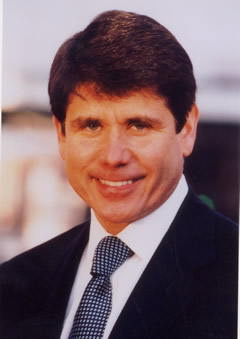 Seriously, folks. Forget that business about selling the Obama senate seat or that Rod Blagojevich, in general, appeared to be a crude and greedy political hack (we hope we're not understating the case).
The Final Report of the Special Investigative Committee prepared for the Illinois House of Representatives cited, among other things, the fact that Rod-the-not-so-mod directed the state to import prescription drugs as a reason for impeachment.
Of all things.
The report noted a bunch of problems, starting with the fact that Rod launched the I-SaveRx program in 2004, despite being advised by the FDA that a drug importation program violated federal law.
From there, the report cited audit findings showing state inspections were not conducted by compliance investigators; none of the pharmacies listed in the program were licensed under Illinois law to dispense pharmaceuticals and none of the medicines shipped to state residents were ever tested, despite promises by Rod's office to do so in collaboration with the University of Illinois College of Pharmacy.
In skewering Rod's performance, the report called the program "a double-blind experiment" that failed. "The Committee finds that, while attempting to help individuals save on the costs of prescription drugs is laudable, it is absolutely essential that the safety of those drugs be ensured and that state and federal laws be followed. The Governor's program failed on all of these counts," the report concluded.
"The Governor violated federal law and, in fact, exposed possibly unknowing participants of the program to federal criminal sanctions. In sum, the Governor knew the program was illegal but allowed it to go forward; and then the program, once implemented, violated numerous State laws relating to safety and quality control of prescription drugs. The Committee finds that the Governor abused the power of his office."
You can imagine what some lobbyists in Washington D.C., are asking over lunch or drinks: 'So do you think anyone in the Obama administration will push for importation now?' (Our answer is here.)
Wednesday, January 28, 2009
Health Care Isolationism
 In his farewell address, former President George W. Bush warned against a retreat into isolationism in response to the global economic crisis—ironically, exactly the opposite theme of the first ever farewell address by George Washington, but then the Bush White House never really did irony, did it?
Still, the US claims to be a leader in globalization, preaching the benefits of economic integration among nations as a force for peace, prosperity and human rights.
Except when it comes to health care. With the US Congress poised to embark on an all-out push to expand and reform coverage in this country, all ideas are on the table—except for ideas directly tied to the experiences of other nations in providing health care to their citizens.
Consider the Congressional Budget Office’s pre-emptive analysis of different health care reform options. The 196 page narrative, accompanied by a series of “scores” of the costs and savings of different proposals, was an initiative of Peter Orszag, who now heads the White House Office of Management & Budget and so will remain a key figure in the health care debate.
The paper offers a number of creative analogies to help understand ways to predict the impact of different policies on the markets, consumer behavior and overall costs. Our favorite: an analysis of the potential impact of insurance mandates looks at prior experience with mandates for vaccines, seat belt use, auto insurance purchase, and income tax payment. (We certainly didn’t know that only 86.3% of tax liabilities were actually paid. Maybe the current rate of insurance coverage isn’t so bad…)
Anyway, amidst all those creative and thoughtful analogies, there is one thing missing: data derived from experiences with universal coverage in other countries around the world. In the 196 pages, we could find just one reference to an international health care system as a model: a study of changes in the availability of medical services in Quebec after universal coverage was adopted in 1970. (We always felt that Quebec should not merely separate from Canada, but join the United States. Perhaps CBO supports that view as well?)
Americans, of course, pride themselves on doing everything in a uniquely American way. And, as Atul Guwande discusses in a recent article in the New Yorker, there really isn’t anything unique about America pursuing a unique version of health care reform. Guwande—a regular contributer to the New Yorker but also a member of the Clinton health care reform team back in 1993-94—points out that every other country to adopt universal coverage did so in its own fashion, evolving out of existing and decidedly local systems already in place.
But we submit that there is more to it than that. Despite what seems to us to be a growing consensus that the US health care system is failing on almost all fronts, it remains politically foolhardy to suggest reforms based on other countries’ models.
After all, if one presidential candidate can accuse the other of being a socialist based on a tax plan that would raise taxes on those making more than $250,000, who would be brave enough to advocate a health system modeled on that of France or the UK or even Japan—much less our neighbors to the north in Canada. (One exception: one of the leading candidates to run the US Medicare and Medicaid agency, Institute for Health Care Improvement CEO Donald Berwick, describes “American exceptionalism” as one of the problems in the way of health care reform.)
So, frustrating though it may be for biopharma companies that operate internationally—many of whom see valuable models and cautionary tales across the globe when it comes to health systems—it seems clear that, when it comes to the politics of health care reform, no one wants to import anything from outside the US.
Except cheap Canadian drugs, of course.
image by flickr user thephotoholic used under a creative commons license.
Tuesday, January 20, 2009
Last Call: Novartis Gets Vaccine Bricks & Mortar Money
 Novartis isn't taking any chances about missing the last call from the government's cash spigot for vaccine manufacturers.
The Swiss company collected the most recent installment of its $865 million in support from the US government before a potential change in attitude towards corporate subsidies by the Obama Administration.
Novartis collected the most recent, and biggest, chunk of that support ($486 million) on January 15, five days before the Obama Inauguration.
Significantly, the new piece includes bricks and mortar, just the kind of direct support to one company – especially a non-US one -- that is most threatened by the change of administration in Washington. Many observers expect the Obama Administration to channel more funds in health to paying for beneficiaries to receive health products and services rather than to support the companies that provide those products and services.
[Editor's note: The publishers of IN VIVO Blog, “The Pink Sheet" and The RPM Report will host a webinar Jan. 29 on the outlook for vaccine developers under the Obama Administration. Dack Dalrymple, Chris Colwell (McKenna Long & Aldridge) and Isabelle Claxton (GlaxoSmithKline) will analyze the prospects for the vaccine business in the next four years. For more information, visit: http://www.windhover.com/ezine/html/ac0109-2lp.htm.]
The January 15 Novartis grant is an eight-year commitment to help Novartis finish building and qualifying its Holly Springs, N.C. facility for the production of cell-culture flu vaccine (seasonal and pandemic/prepandemic). The new money is for “design, construction, validation and licensing.”
The company got $220 million from the Department of Health & Human Services in 2006 (before selecting Holly Springs as the manufacturing site) to begin developing a cell-based vaccine. Novartis says that the first round of funding “was not for the facility, land or building.” The $865 million also includes funding for development work on adjuvants and a chunk awarded to Chiron to help get its flu vaccine production back up to par just prior to the major Novartis purchase of Chiron to get into vaccines in a big way.
By collecting commitments for $865 million from the U.S. government over the last three-plus years, Novartis has successfully defrayed much of the cost of expanding into the vaccine business. The company paid $5.7 billion to buy the part of Chiron that it did not already own in early 2006. The grants do not obviously relate directly to the cost of the initial purchase; but as a marker of the size of support for the Swiss company’s engagement in the vaccine business, the US funding represents more than 15% of that initial investment.
Novartis indicates that commercial production from Holly Springs is more than three years away. “Construction activities will continue until late 2010,” the firm says. After than, “engineering and process validation will start,” continuing through 2011-2012. FDA clearance procedures will follow the process validation.
Holly Springs will eventually produce bulk prepandemic vaccine (vaccines designed against projected pandemic strains), the MF59 adjuvant to permit lower doses of antigen in the flu vaccines and other cell-based vaccine products. By the January 15 contract, Novartis is committed to provide two commercial-scale lots of prepandemic vaccine annually to HHS for at least three years.
The new funds will help pay for the regulatory clearance, which can be a significant cost. The Congressional Budget Office has recently estimated that the FDA approval process can add approximately 25% to the initial construction cost for a new vaccine plant.
CBO, in fact, analyzed the projected government and private spending to develop cell-based vaccine manufacturing in mid-September of last year. At that point, CBO reported that HHS was intending to spend up to $600 million to support the creation of new facilities for cell-based manufacturing – as opposed to the traditional egg-based production system. The Novartis contract does not leave much left (about $115 million ) from those estimated funds.
CBO noted that Novartis says that the total cost for Holly Springs will exceed $600 million. As we reported soon after the Chiron purchase, Novartis has said from the start that Holly Springs would cost between $600 million and $700 million. CBO says other vaccine industry sources have estimated that it should cost Novartis less (about $400 million). Novartis is indicating that the final cost could be well over $1 billion.
The other big participants in the flu vaccine expansion: primarily Sanofi-Pasteur, GlaxoSmithKline and Medimmune (AstraZeneca) have also been beneficiaries of HHS largesse. Sanofi and Medimmune have received respectively $77 million and $55 million to retrofit existing flu vaccine plants.
Novartis, however, claims that it will eventually contribute a larger share (60%) to the total cost of Holly Springs than other manufacturers have put into government-supported retrofit projects. Sanofi and Medimmune each put about 25% into the projects funded by the government. CBO said that companies should be expected to put more in for the development of new cell-based manufacturing facilities.
GSK is developing a site in Marietta, Pennsylvania purchased from Wyeth for increased flu and pandemic production in the US. GSK is nearing the stage to seek FDA approval for filling and packaging of vaccines for use in the US from antigens made overseas. GSK has been reluctant to accept much direct funding for construction for the vaccine production projects: people close to the GSK effort say that the restrictions inherent in government contracts reduce the value of the subsidy funds.
The Bush Administration has really created a new vaccine industry in short order by pumping in money, making use of the public concern for a potential pandemic. Now, the new producers are likely to lobby the new administration to make sure that the products from the new production capacity find an adequate market.
