


 When it comes to drug development, the Food & Drug Administration is starting to think small. Really small.
Nanotechnology—the manipulation of matter on the scale of a billionth of a meter—has gotten the attention of FDA regulators. And while nanotech has been mostly used for cosmetics and OTC drugs like high-tech sunscreens, the science is starting to move in the direction of pharmaceutical and biotechnology applications.
As Ellen Licking wrote in a recent issue of START UP, there are a handful of nano-based prescription drug products out on the market, like the aprepitant nanocrystals Merck markets as the antiemetic Emend, and the albumin-coated molecules used in Abraxis Biosciences’ breast cancer drug Abraxane.
And while none of the marketed nano drug products are exactly blockbusters, there are a few drug delivery companies with dreams to change all that by producing next-generation, “me-better” therapies that are safer or more efficacious than existing products. These young upstarts include BIND Biosciences, Tempo Pharmaceuticals and Liquidia Technologies.
Those invested in nanotech have great expectations for the science. Noubar Afeyan, PhD, a managing director with the Boston-based VC firm Flagship Ventures, told START-UP that nanotechnology is a “whole new way of thinking about designing a drug…that hasn’t been available before.” And talk about bullish: David Sarphie, PhD, CEO of Bio Nano Consulting, predicts that by 2015 nanotechnology will play a critical role in the delivery process or development of up to 60% of biopharma products.
Regardless of whether one buys into the nanotechnology hype, FDA sees it as significant enough to take a closer look. An internal task force released a report on nanotech last year, the findings of which will be discussed September 8 at the latest in a series of public meetings on nanotech-y issues. Topics for discussion will include:
(1) The type of information and data that may be needed to demonstrate the safety and effectiveness of FDA-regulated products containing nanoscale materials and;
(2) The circumstances under which a product's regulatory status might change due to the presence or use of nanoscale materials (for example, making a device no longer exempt from 510(k) submission requirements).
Expect some controversy at the meeting. Like other new-tech areas like genetically modified foods, not everyone is thrilled about the prospects for nanotechnology. Do a Google search of “nanotechnology” and “safe,” and you’ll come up with a whole host of organizations that question whether FDA should be keeping tighter control over nanotech.
But there is some concern about whether FDA even has the authority and resources to regulate nanotechnology. Plus, nanotechnology extends into other sectors, like clothing and consumer goods, which raises still more questions. If the agency can regulate some nano products, but not others, will that ultimately damage the prospects for the entire science?
Those questions certainly won’t be resolved anytime soon, but given the interest in really, really small things—as well as new ways to improve upon existing products—the meeting is worth checking out. We'll certainly be there.
Thursday, August 14, 2008
FDA Thinks Small: Next Steps for Nanotech

Tuesday, August 12, 2008
The Case for Byetta LAR (Part 2)
 Amylin and Lilly have high hopes for Byetta LAR, a once-weekly formulation of the incretin mimetic exenatide. Analysts are (as they tend to be) of two minds, with opinion ranging from those who think LAR may fairly quickly become the dominant brand in the entire diabetes class to those who wonder whether it will even make it to market.
We will leave the debate over the commercial prospects to others. But we do think LAR looks to have a winning profile from the regulatory perspective.
That, to put it mildly, is counterintuitive. We just wrote that it is harder than ever to get new type 2 diabetes drugs on the market. And we’ve said previously that it is harder than ever to get line extensions to market. (Remember Cordaptive?) That sure doesn’t sound like a good prognosis for LAR.
But this may be a case where two wrongs do in fact make a right.
How so? Well, first, this is a circumstance where it definitely helps to be developing a line extension rather than a new molecule. Here is how Amylin CEO Dan Bradbury described the situation during Amylin’s second quarter conference call. “The FDA panel meeting really focused on cardiovascular risks associated with new chemical entities,” he said. “That is one of the major differences here.”
Indeed, the panel vote does imply that marketed antidiabetic products just got a little more valuable. In fact, one implication of the latest advisory committee vote is that the decision by FDA to leave Avandia on the market is an even bigger victory for GlaxoSmithKline than it appeared. (An advisory committee voted overwhelmingly last year to allow continued marketed of the drug. FDA’s internal Drug Safety Oversight Board agreed, but by a single vote. And ultimately the decision came down to CDER Director Janet Woodcock, who opted to allow continued marketing.)
Now, Avandia (like other marketed products) will be expected to generate outcomes evidence—but at least it can continue to generate revenues in the meantime. And the odds of another TZD coming into the market any time soon just when down. So maybe, just maybe, GSK will actually see sales of the franchise rebound a bit in the years remaining before patent expiry.
But Byetta LAR is not a case of asking FDA to approve a new agent to lower blood sugar, but rather a case of asking FDA to approve an improved version of an already marketed drug. And, in fact, of a drug that has an attractive cardiovascular risk profile, given Byetta’s effects on weight and lipid levels.
That alone, though, may not be good enough in the current regulatory climate. But here’s the kicker: FDA can use the LAR approval to ensure it gets the outcomes data to support its decision to approve Byetta in the first place. The agency, of course, already asks for that data routinely—but as everyone saw with Avandia, those post-marketing commitments are seldom sufficient to generate definitive conclusions about the kinds of questions the committee now wants answered.
FDA, though, has a new tool it can use going forward: mandatory post-marketing study requirements, complete with the ability to levy fines against manufacturers who fail to deliver data by an agreed upon time. As we’ve said before, this changes everything about Phase IV.
The new authority is much easier for the agency to apply prospectively, to newly approved drugs (or at least new applications for expanded uses, new labeling, etc.). The agency can (and in the case of type 2 diabetes, we bet it eventually will) go back and add post-marketing requirements to already marketed products, but that is a process that will take some time.
So, Lilly and Amylin have a two-fold case for Byetta LAR. It is an improvement over an already marketed drug (since, the companies say, it provides better glucose-lowering control and increased convenience)—and it also gives FDA the opportunity to finalize mandatory outcomes studies for exenatide sooner than it otherwise could.
And, as an added bonus, it fits perfectly with the companies’ commercial positioning of the product. Lilly and Amylin are already planning a large cardiovascular outcomes study based on extensive trials suggesting beneficial effects on surrogate endpoints. So it shouldn’t be hard for them to commit to FDA to do such a study as a condition for approval.
All of which means Byetta LAR may turn out to be the right product for the current regulatory climate.
Of course, if the commercial product isn’t the same as the one used in clinical trials, all bets are off…
Monday, August 11, 2008
Comparative Effectiveness Compare and Contrast
 Since Sen. Max Baucus introduced his latest legislative attempt to create a national center on comparative clinical effectiveness research, we’ve had some time (OK, OK, a week—it is summer, after all) to dig into the details.
With the help of our colleagues over at “The Pink Sheet,” we’ve put together a list of some of the key differences between the Baucus bill (S 3408) and previous comparative effectiveness legislation—including language in the senator’s own Medicare Part D price negotiation bill from 2007.
So here’s a little compare and contrast, as reported in this week’s issue of The Pink Sheet.”
Organizational structure: Baucus would create the “Health Care Comparative Effectiveness Research Institute” as an independent, public-private entity. Past efforts had the Agency for Healthcare Research & Quality as a central player: The CHAMP Act would have established a center inside AHRQ, and Rep. Tom Allen (D-Maine)'s bill would have established a trust fund through the quasi-government agency.
Who sets the agenda?: Research priorities would be determined by the center itself. That’s a change from the comparative effectiveness language in Baucus’ Medicare Part D price negotiation bill, under which HHS would set the research agenda. But the government would have some influence over what would be studied: the HHS secretary and NIH director would sit on the governing board.
Money, money, money: Baucus calls for appropriations of $5 million in 2009, $25 million in 2010 and $75 million in 2011. Starting in the fourth year, annual contributions would be made from the Medicare Trust Fund ($1 per beneficiary per year), revenues generated by a fee on private health insurance policies ($1 per insured person per year); and general revenues ($75 million a year). Funding would increase to $300 million a year by the year 2013, and all funding would sunset after 10 years.
By comparison, the CHAMP Act set government appropriation levels at $90 million, $100 million and $110 million during the first three years, but was not as direct in setting levels for private participation. The bill said that the private sector contribute beginning in the fourth year to bring the total trust fund amount of $375 million.
And then there’s the billion-dollar question for industry….
How will the research be used?: Baucus does not offer any specific guidance on how the information can or cannot be used by private or public payors. That’s a big change from the price negotiation bill, which clearly stated that “authorizing consideration of comparative clinical effectiveness studies in developing and reviewing formularies under the Medicare prescription drug program.”
The Case for Byetta LAR (Part 1)
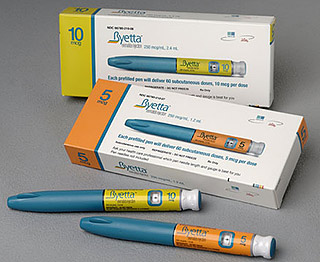 Lilly and Amylin say they have one regulatory hurdle to cross before filing for the long-acting formulation of exenatide (Byetta LAR): demonstrating comparability between the clinical formulation of the drug and the proposed commercial supply manufactured by Amylin in Ohio.
Amylin CEO Dan Bradbury told investors during the company’s second quarter conference call July 21 that a recent meeting with the agency gives the company great confidence in its projection of an NDA filing sometime in the next year. The company has said all along that it expects to file by the end of the first half of 2009, Bradbury said; the meeting with FDA suggests that timeline may be conservative, since the agency may end up not requiring a full-fledged clinical crossover study.
At a time when investors are focused on the now clear, unequivocal emphasis on outcomes endpoints for new type 2 diabetes drugs, Amylin’s confidence in a near time filing date for Byetta LAR is big news.
This is a tough time for type 2 diabetes drug development. An FDA advisory committee essentially endorsed the Steve Nissen worldview: that blood sugar reduction is not an end in itself, and new drugs for use by diabetics need to provide sufficient evidence of outcomes benefits—especially cardiovascular outcomes—as a condition for approval.
Our colleagues at “The Pink Sheet” have extensive coverage of the meeting, and—more importantly—FDA’s takeaways from the meeting.
But in case you missed it, after a morning’s worth of warm-up, Steve Nissen—Cleveland Clinic cardiologist and shadow FDA commissioner—went up to the podium and called out the entire profession of endocrinology, telling the committee that they have made glucose reduction a goal in itself and lost sight of the bigger picture. Some committee members fumed visibly—but the panel spent the next day-and-a-half following the agenda laid out by Nissen.
The committee agreed with his premise—that it is no longer acceptable to approve drugs solely based on the ability to reduce HbA1c levels—and with his overall approach to assessing cardiovascular outcomes. They punted on some questions—like exactly how much outcomes research to expect, and under exactly what conditions the studies would be necessary prior to approval instead of as post-marketing commitments.
So what does all this mean, other than demonstrating once again the incredible influence Nissen has on drug development and use in this country at this moment in history?
First, it confirms that the bar is indeed higher for type 2 diabetes drugs, that—in effect—they will be governed by a quasi-superiority standard of the type that FDA has begun talking about for NSAIDs (and now antipsychotics).
That in itself should not be news: Remember Pargluva? But it is now clear that new agents for glucose reduction will be expected to demonstrate some compelling reason for approval—better HbA1c control, evidence of reduced toxicity, something—or else face the risk of being asked for definitive proof of outcomes prior to approval.
So there is plenty of reason to wonder whether Lilly and Amylin can in fact move forward with LAR as planned (or even faster than planned).
We think they can…and we’ll explain why tomorrow.
Is There Another Roche-Genentech Out There? Signposts for the Rare Beast
 The emotional dust raised by Roche’s takeover bid for Genentech has largely settled (you can download a free collection of our coverage of the event and some of its implications, here).
But there’s still plenty of strategic dust obscuring the view. The Genentech/Roche model – the most admired relationship in industry history -- seemed almost uniquely able to solve two enormous challenges: biotech’s ability to access capital and Pharma’s to feed its pipeline.
We don’t believe that Roche's move to acquire its junior partner means the structure can't work elsewhere. Roche simply figured Genentech’s run of innovation was close to the an end, and that the deal’s cost of accessing further innovation (royalties, milestones, geographic limiations) was simply not worth the candle.
But the fact is that the model has been rarely attempted. Here’s why. Thanks to a unique confluence of partnering requirements, Roche and Genentech both got something they needed from this deal without insisting on getting more (until Roche did by announcing its bid for Genentech). That set of circumstances has rarely occurred in the past -- and will rarely do so in the future.
To review these circumstances: Genentech wanted to fund R&D at what it believed was the requisite level – but couldn’t without killing its share price and thus closing off its access to capital. Not so rare a situation, by any means.
So it convinced Roche to offer Genentech stockholders a generous put on their shares: if the stock began trading too low, Genentech shareholders could force Roche to buy them out. That meant that Genentech’s shares could only fall so far while its competitors in the game of attracting capital could make no such reassuring promise. Many had to – still have to -- overdose on dilution.
But that put cost Genentech something few biotechs would be willing to pay today: a fixed-price option for ex-US rights to its pipeline. The option, which secured Roche some of the most successful biotech drugs, was based on deal prices from the mid-90s. Now, no one could really forecast the extraordinary inflation in deal values consequent upon the equally extraordinary lack of R&D productivity in Big Pharma (not excepting Roche). But it’s hard to believe that anyone today, knowing now what we’ve learned about biotech dealmaking over the past decade, would agree to that kind of fixed-priced option.
The option didn’t turn out to be all that bad for Genentech either. As we could not forecast inflation in deal prices, we could not have forecast the ability to regularly charge $50,000 for a course of therapy applicable to hundreds of thousands of people. Genentech, in short, limited itself to the US market at precisely the moment the US market was at its most lucrative for the kinds of products Genentech was selling.
And one other thing: Roche was getting something it could not develop on its own or easily find on the outside: large-molecule discovery, development, production and marketing capabilities. Roche couldn’t duplicate Genentech’s pipeline. That means that there were relatively few entrenched interests at Roche who would see Genentech as duplicating their own efforts -- and therefore competition. Moreover, because Genentech had actually created three approved products (and developed and sold two of them – TPA and human growth hormone; Lilly developed and sold the third, human insulin), Genentech’s pipeline didn’t look like a pipe dream.
So: a rare set of circumstances. There are several companies, like Genentech, with a platform for producing a new kind of drug. But few of them would be willing to sell a fixed-price option to their entire pipeline. The pressures on US pricing (compounded by the likely advent of biosimilars) will force companies to be stingier in parceling out ex-US rights all at one go. Moreover, there aren’t many companies like the Genentech of 1995, which had successfully developed and commercialized products -- but which still needed help in accessing capital. Celgene, for example, certainly doesn’t need Big Pharma’s guarantee to wring money out of Wall Street; nor does Genzyme; nor does Gilead.
The two closest recent examples of a Genentech/Roche-like model – the Idenix/Novartis transaction from 2003 or the Theravance/GlaxoSmithKline deal of 2004 – don’t exactly shine as examples of successful development organizations. Moreover, neither of those companies provide their would-be acquirors any special new platform. Theravance, in fact, is all about me-better small-molecule drugs. And the fact that GSK chose its own long-acting beta agonist to work on, rather than Theravance’s, does at least call into question the acquisition value of Theravance’s platform – indeed, last year GSK formally decided not to acquire the additional Theravance shares it could have.
So, granted the rarity of candidates, who might fit? Which companies with unique or at least important R&D platforms have produced an approved but only marginally successful drug … and who thus would be willing to pay a price similar to the one Genentech paid in order to access capital at a reasonable rate?
RNAi platforms are certainly hot. But none of the independent RNAi players (like Alnylam or Silence) has actually developed a drug let alone proven that the platform actually can produce them. Too early for the 60% solution.
Aptamers haven’t generated huge partnering buzz but there’s at least one on the market (Macugen, from Eyetech/Pfizer) so Archemix, granted it can push its pipeline along, might be a good candidate for a 60% deal (the VCs in that company which have been unable to get it public would be happy with such an outcome).
Isis Pharmaceuticals’ antisense platform has attracted various partners; it’s got a late-stage program in development, mipomersen, that it pushed through on its own. But the market likes Isis now; the stock has dramatically outperformed the biotech index. So if we were CEO Stan Crooke we might insist on a bit more valuation than most Big Pharmas would be willing to tolerate – particularly since the company already sold Genzyme the rights to mipomersen. So: better candidate than Alnylam (would Genzyme’s Termeer do a 60% deal for Isis? We think he’d consider it) but not so good, or as inexpensive, as Archemix.
Exelixis has managed to put together a pretty fair set of targets and chemistries; has gotten a few products into pivotal trials, albeit none further than that. But it sure hasn’t secured the unalloyed confidence of investors. That combination of scientific quality and market skepticism has made Exelixis attractive to, and attracted by, innovative financiers like Symphony Capital and Deerfield – and which probably would attract them to a 60% acquirer, were one to come along. But it’s not clear to us that an acquirer would be as interested: small molecules are Pharma's bread and butter, too close to what they think they already know.
And a few ideas a bit further afield.
Big Pharma is increasingly interested in generics, particularly of the large-molecule variety. Might make sense for investor-poor, technology-rich Momenta to stay quasi-independent but let a Big Pharma sell its biosimilars as part of a push into emerging markets.
And then there's China; could Pharma tap into that increasingly attractive and rapidly transforming market by teaming with a service play like WuXi Pharmatech or a still-small and home-grown biotech play like Hutchison China-Meditech's recently emancipated MediPharma subsidiary?
So another Roche/Genentech is possible. Likely? Not so sure. Because there was one other element to that we haven't discussed: strategic courage. And that may be the rarest element of all.
Image from flickr user Steffe used under a creative commons license.
While You Were at the Beer Festival II
 For those of you expecting an Olympic theme to the weekend roundup, well, there's always next week. Because this weekend we enjoyed our annual pilgrimage to the Great British Beer Festival in London. A quick review was in the works until a quick look at last year's beer festival post revealed we were about to say pretty much the same exact thing.
Suffice to say that Sharps, Caledonian, and Hook Norton were bringing their A-game as usual (wish we could say the same about our photographer). Another stalwart putting in a good showing was Cairngorm; its Trade Winds was particularly nice though we're still leaning toward old favorite Sharps' Atlantic IPA as our beer of the fest. A nice surprise for us was a lemongrass beer from Hop Back, Spring Zing.
There was little industry news with zing over the weekend, so we've put on the beer goggles so you don't have to:
- Pfizer has reached another settlement over a generic Lipitor, Reuters reports, though there are no details available regarding the Big Pharma's deal with Apotex.
- IMC11F8 is the catchy name given to Imclone's next-generation, fully human antibody viewed by many as a son-of-Erbitux. The candidate, not yet in pivotal trials, is at the core of the ongoing BMS/Imclone negotiation, points out today's Wall Street Journal. Bristol claims rights to the follow-up under the companies original 2001 alliance. Imclone disputes that entitlement, though hasn't always done so, says the Journal.
- Via the SF Chronicle, one doctor's crusade to, uh, get a cool epocrates application on his iPhone so he didn't have to carry around an extra gadget.
Friday, August 08, 2008
Deals of the Week: We're Back
 Didja miss us? Not even a little?
Expect posting to return to its normal erratic schedule as of next week, and enjoy this dog days of summer deals-of-the-week post as you gear up to watch what is sure to be an unintentionally psychedelic opening ceremony for the 2008 Summer Games in Beijing.
We may have missed a few interesting tidbits over the past couple weeks--such as CytoChroma's alliance with Mitsubishi-Tanabe, GSK's layoffs, and probably a whole lot more (the logical conclusion to the BMS/Imclone saga trundles along though, so i'm sure we'll have a chance to chime in later).
And we'll make it up to you: be sure to check in next week for a complimentary PDF of our coverage (to date) of the Roche/Genentech situation ... for now you'll have to make due with:
Lilly/Covance: Read our earlier post on Lilly's leadership in creative financing of R&D, here (or just scroll down).
The Medicines Co./Curacyte: In a play to get its hands on Curacyte Discovery's lead CU-2010 serine protease inhibitor, The Medicines Co. has acquired the German biotech for €14.5 million up front plus a potential €10.5 million milestone should the drug move into Phase II (a royalty and commercial milestone payment enter the mix should 2010 hit the market). The move is unusually early-stage for MDCO, and as our colleagues at The Pink Sheet DAILY point out, driven by the uncertain fate of the patent situation around the company's Angiomax franchise.
Roche/Metabasis: Liver specialist Metabasis announced on Thursday a deal with Roche to give the Big Pharma's HCV nucleoside drugs better liver-targeting properties. The tweaking will cost Roche $10 million up-front for the two-year research collaboration and up to $193 million in milestones plus a royalty should a development candidate be selected. Though it might seem like the liver is the organ most drugs will find even if blindfolded and spun around three times, Metabasis' technology is designed to allow for lower dosing of drug, and therefore better side-effect profiles--a welcome scenario in a space where nucleoside HCV polymerase inhibitors have failed thanks to more problematic risk/benefit ratios than expected.
Celgene/GPC: It has been a rough road for GPC ever since the next-generation oral platinum chemotherapy satraplatin hit the skids last October. On Wednesday, the biotech's European commercial partner, Celgene, which inherited the deal from Pharmion, pulled the plug on the firms' collaboration and approval anywhere seems unlikely without a new clinical program. Celgene had yanked the drug's European MAA last week, and the writing was on the wall. GPC continues to evaluate M&A opportunities.
The REMS Pioneers: GlaxoSmithKline Edition

The REMS is the centerpiece of the new drug safety legislation enacted in 2007, giving FDA much greater authority to regulate drugs on the market using tools like consumer medication guides, enhanced communication programs, and restricted distribution. (If you haven't been keeping up, you should be: start here.)
Remarkably, one sponsor--GlaxoSmithKline--has been involved in four of the first seven. GSK (or its partner) has negotiated a REMS as part of the approval process for the migraine combo Treximet (developed by Pozen), a broader indication for Advair, the new drug Entereg (developed by Adolor), and a pharmacogenomic safety screen on Ziagen. (And GSK isn't done: another REMS is in the works for the pending Promacta application.)
The other REMS all involve different sponsors: UCB's new biologic Cimzia, Biovail's new salt formulation of bupropion Aplenzin, and a revised label for Schering-Plough's Intron A.
So GSK's regulatory affairs group sure has been busy lately, since the new REMS authorities involve unchartered territory for both FDA and the sponsors.
But don't feel too bad for GSK. The company has had more than its share of the early work on navigating the REMS process--but it also has benefited in at least two ways.
First, as we wrote here, the intial wave of REMS pioneers have all involved applications stuck at FDA. So GSK has shouldered a greater burden in figuring out how the REMS will work in the regulatory process, but it has been rewarded with the opportunity to sell two new products--Treximet and Entereg--that might not otherwise have been marketed at all. The broader labeling for Advair also helps the company tell a good news story about the drug at a time of ongoing safety concerns for the long-acting bronchodilator class.
The Ziagen REMS may be the most interesting of all--a real world case-study in personalized medicine--but its hard to say it is paying off for the sponsor. (You can read more about that REMS in "The Pink Sheet.")
Here's the second payoff for GSK: the company now knows the most about how the new drug safety regulatory system works. FDA officials have put it better than we can: this is the most important change in the drug approval process in generations, and essentially every new approval sets a precedent. FDA plans to draft guidance to explain the new system to sponsors, but not until it has more experience. So the only way to learn is by doing.
GSK finds itself as the early leader in that learning.
Now, does that pay off in a competitive advantage for the company as it tries to get more drugs to market? We'll see....
Thought-Leadership in Hoosiertown: Lilly’s Innovations in Pharma Finance
 It was hardly groundbreaking, as the Covance/Lilly deal was described by one of the PR flaks who’d pre-alerted us to the deal (you can read more of our Pink Sheet Daily coverage here).
But as one piece of the overall strategy Lilly has been fitting together over the last few years, it does indicate to us that those isolated Indianapolites are now the leading Big Pharma thinkers when it comes to financing R&D.
Let’s not go overboard here. The Covance deal isn’t a brand new concept. Aventis (and a few others) did more or less the same thing with Quintiles in the previous decade (see this piece, for example: you can get it for free and it will outline the key issues Lilly also had to wrestle with).
But add this deal together with Lilly’s recent three-way Alzheimer’s funding/development program with the private equity firm TPG-Axon and Quintiles’ NovaQuest unit, plus Lilly’s Asian forays in cooperative discovery (see this analysis, for example), and the company’s FIPNet notion is looking like a lot more than a marketing slogan.
Lilly, in short, seems almost uniquely serious about both variabilizing and off-loading development expenses. The first bit is pretty easy and relatively popular – all drug companies want to cut expenses. Lilly’s sale of a standalone drug-development facility and transfer of employees is simply one technique among many (like firing people, an activity with which Big Pharma has gotten a lot more comfortable over the last two years).
The second bit is harder: we haven’t seen any Big Pharmas except Lilly turn in a big way to private equity to help them fund high-risk R&D and share in the returns. (Lilly and other Big Pharmas have let NovaQuest take on some development risk in return for milestones and royalties, but those are pretty limited deals; Bristol has of course rather famously turned for financing and development help to other Big Pharmas).
There have certainly been plenty of discussions with PE – we ourselves know of several. But by and large the investors we’ve spoken with want more than just a couple of high-risk projects in these financing arrangements – they want a market basket of compounds, and so far as we know, no major drug company has been willing to share the upside that broadly. (Interesting that Mikael Dolsten, who was running an incipient Pharma-funding operation for Orbimed, gave up that job to run Wyeth’s R&D organization.)
In this regard, the Lilly/TPG deal was a compromise: two different Alzheimer’s compounds, both about ready to start Phase III trials, but hardly the four or five programs that would make most PE players comfortable with the development risk.
CROs, meanwhile, are anxious to take advantage of Big Pharma’s new attitude toward infrastructure and risk sharing. Their businesses are booming with Big Pharma’s boom in Phase I and II programs; they need more people to handle the additional trials. Getting them from Pharma in a friendly sort of way is good business for two reasons: the drug company pays the costs of their new employees for the first year or two; and it’s likely that the Pharma will be more inclined to send a preponderance of their new business Covance’s way. We very much doubt, incidentally, that other Big Pharmas will shun Covance because it is too cozy with Lilly: there’s simply too much momentum towards outsourcing in general.
If this merry-go-round of employee transfers stops – it’s fueled by the boom in early-stage productivity -- the CROs will be stuck with the firing duties and expenses of doing so, as was Quintiles when it ran into problems earlier this decade (problems which, among others, eventually led to its LBO). But in 2008 – unlike 1999 -- drug companies are pretty committed to outsourcing; should their mid-stage pipelines dry up any further, they’re as likely to layoff more of their own employees as they are to use them on work taken back from CROs.
Image from flickr user Marttj used under a creative commons license.
Thursday, August 07, 2008
Temple and Comparative Effectiveness Standards Revisited

We haven’t changed our minds on the importance of FDA’s decision to reject the company’s atypical antipsychotic iloperidone and some of the regulatory and policy issues it brings to the fore.
We quoted comments from FDA’s Bob Temple at a July 30 Institute of Medicine meeting on evidence-based medicine. Temple heads up the office which regulates psychopharmacologic drugs and also serves as director of FDA’s Office of Medical Policy.
At the meeting, Temple said this:
“We have taken a couple of steps that I think are interesting. We’ve turned down new antipsychotic drugs because they didn’t seem as effective as the available therapy. I can’t remember if that ever happened before or whether we didn’t have the [courage] but we did. We decided that it wasn’t good if you’re an acute schizophrenic in the middle of an episode to be treated poorly.”
Our story has generated a number of comments, but we thought you’d be most interested in this one from Temple himself, who says we didn’t get it exactly right when analyzing his remarks at the meeting.
“Some of what I said is misinterpreted,” Temple said in an email. “At the IOM, I was explaining what I perceive drug companies to be perceiving and doing, not describing an FDA standard. That is what I was referring to when I said that ‘It’s getting harder to develop the third, fourth, fifth, and sixth member of a class of drugs because when there’s a generic available [within a class], people are inclined to use the cheap one.”
Our mistake. We thought we communicated that but after re-reading our story, it was confusing. Here’s the rest of Temple’s comments in their entirety. When Temple speaks, we always pay attention.
Temple: “Your next sentence said that comparative randomized studies ‘are the best, and maybe only, way to get drugs through FDA.’ That interpretation and conclusion are incorrect, and surprising, as your next sentence seems to recognize the commercial aspect of what I was saying: ‘To get anyone interested in the next member, you almost need to have some sort of advantage.’
It seems apparent that in my statement I was referring to my impression of what companies are doing to have a commercially viable product when there is a generic available for the drug class, and was not referring to any FDA requirement. In most settings, especially for symptomatic treatments, we do not get or ask for comparative data and are perfectly willing to approve a drug that is shown effective.
I did then go on to say that for antipsychotics (not naming a particular drug) we have rejected drugs that seemed clearly inferior to standard treatment because leaving someone with schizophrenia inadequately treated (which can take weeks to recognize) represents a risk. This is not so novel a position. We ask that new antibiotics, new anti-cancer drugs, new drugs intended to save lives or prevent bad outcomes (stroke, heart attack) have effects close to standard treatment for the same reason - importantly decreased effectiveness is not safe. We had not seen examples of anti-psychotic drugs that were markedly less effective than standard therapy; so I’m not sure you can really say that there's a new higher threshold.”
When looking at Vanda’s iloperidone, we still think there’s little room for negotiation on whether the company will have to do a head-to-head study against Risperdal. The company will have to decide whether it’s worth the money—and risk.
